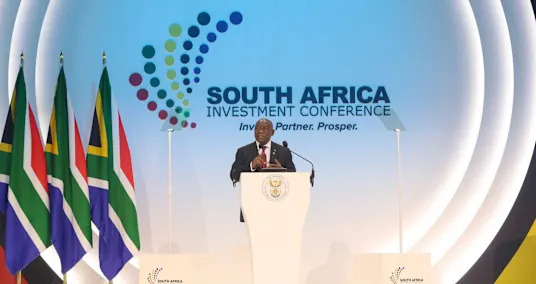
South African President Cyril Ramaphosa launched a nearly $200 billion investment drive aimed at accelerating economic recovery and industrialization in the face of growing worry over the impact of the Iran war on the continent’s biggest economy.
For more than a decade, South Africa’s economy has barely grown, leaving it with crumbling infrastructure and the need to create jobs in a country where one in three people are unemployed. Ramaphosa’s pitch to investors in Johannesburg this week was that South Africa has fixed the worst bottlenecks: He said the country is opening key sectors to private capital and is ready for large scale investments.
Ramaphosa said the effort will run through 2030 with delegates at the South African Investment Conference pledging $53 billion across 31 projects spanning energy, logistics, manufacturing, and digital infrastructure. They include Coca-Cola’s $1 billion expansion plan, and a $3.6 billion commitment from Sasol — the world’s biggest maker of fuel from coal — to upgrade operations.
LATEST POSTS
- 1
 Step by step instructions to Think about Disc Rates Across Various Banks
 - 2Hostile to Maturing Skincare Items to Rejuvenate Your Skin
- 3First stop, the Moon. Next stop, Mars? Why Nasa's mission matters
- 4Extravagance SUVs for Seniors: Solace, Innovation, and Security
- 5David Duchovny's new thriller has him stripping down at 65. But its chilling premise hits close to home.





- Trump signs bill allowing whole milk to return to school lunches
- Transform the daily grind to make life more interesting – a philosopher shares 3 strategies to help you attain the good life
- False fuel prices in fabricated graphics circulate in Malaysia as Iran war continues
- Liste des pr\u00eats qui ne n\u00e9cessitent pas de remboursement
- Why the UAE has incurred the wrath of Somalia
- Instructions to Pick the Right Gold Speculation Procedure: Exploring the Market
- Human evolution’s biggest mystery has started to unravel. How 2025 tipped the scales
- Iran war pushes Germany's deficit to 4.2% as growth outlook is cut by 50%
- 4 buzzy new TV shows to watch — plus the return of 'The Comeback,' 'Jury Duty' and more